Budget-Friendly Tiny Home Decor Ideas for Families: Style, Function, and Fun in Small Spaces
Living in a tiny home with kids is one of the most creative parenting challenges out there. You're working with limited square footage, real-world chaos, and a budget that needs to stretch. The good news? Families who've figured this out will tell you the same thing: small spaces force you to be intentional, and that intentionality often produces homes that feel more personal and more functional than houses three times the size.
Why Decorating a Tiny Home with Kids Is a Unique Challenge
Decorating a tiny home with children is different from standard small-space design because kids generate stuff — art projects, toys, sports gear, school supplies — and they need room to play, learn, and just be kids. Generic minimalist advice doesn't account for a six-year-old's stuffed animal collection or a toddler who needs floor space to build block towers.
The real tension isn't just aesthetic. It's functional. You need surfaces that wipe clean, storage that kids can actually use, and a layout that doesn't make everyone feel like they're constantly in each other's way. That's a harder design problem than "pick a neutral palette and declutter."
The families who thrive in tiny homes don't try to pretend kids don't live there. They design with kids in mind from the start — and that changes everything about how you approach furniture, storage, and decor.
Start with a Plan: Zones Over Rooms
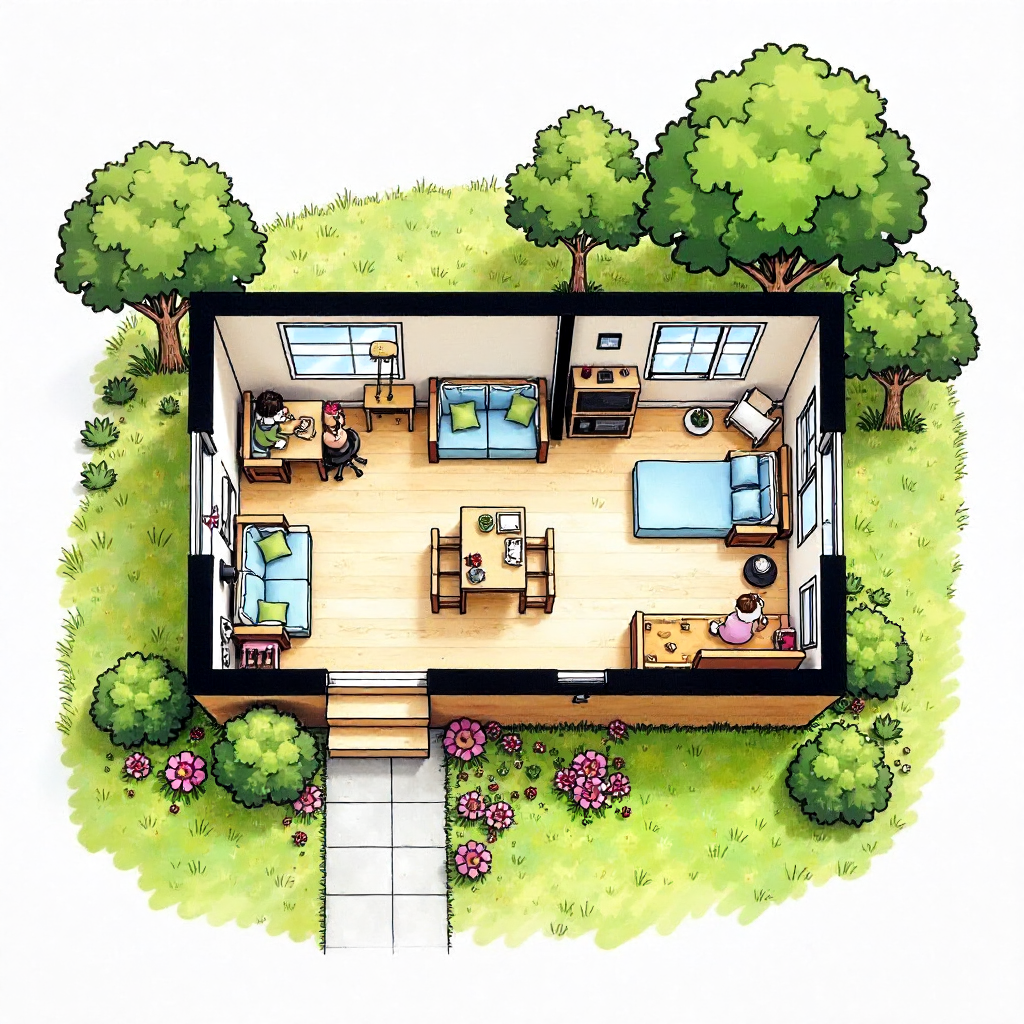
Before buying a single piece of furniture, divide your tiny home into activity zones rather than thinking in terms of traditional rooms. Zones define purpose without requiring walls — and they make a small space feel organized and intentional instead of chaotic.
Think about the activities your family actually does daily: sleeping, eating, homework, play, and adult downtime. Each of these can have a designated zone, even if it's just a corner of a shared space. A small rug and a low bookshelf can define a reading nook. A fold-down wall desk signals "homework happens here."
This zoning approach has a practical bonus with kids: when everything has a place and a purpose, tidying up becomes faster. Children understand "toys go in the play zone" more easily than abstract tidiness rules. Sketch your zones on paper before moving anything — it takes 20 minutes and saves weeks of rearranging.
Multi-Functional Furniture That Does the Heavy Lifting
Multi-functional furniture is the single most impactful investment you can make in a tiny home with kids — and it doesn't have to be expensive. The goal is every piece doing at least two jobs.
Storage ottomans are a perfect starting point. They cost $30–$80 at most big-box stores, serve as seating, a coffee table, and hidden toy storage all at once. A bench with built-in cubbies at the entryway handles shoes, backpacks, and outerwear without eating floor space.
Loft beds and bunk solutions are transformative for families sharing sleeping areas. A loft bed frees up the entire footprint underneath for a play area, desk, or dresser. You can find solid loft bed frames secondhand for $50–$150, and they're one of the highest-impact changes you can make to a child's sleeping zone in a tiny home.
Fold-down tables mounted to walls are another underused option. A wall-mounted drop-leaf table serves as a homework station, craft table, or dining extension — and folds flat when not in use. Paired with stackable stools that slide underneath, you've created a full activity station that disappears in under a minute.
One honest trade-off: multi-functional furniture often requires more deliberate use. A fold-down table doesn't work if it's always buried under stuff. These pieces reward families who commit to the "everything has a home" mindset.
Vertical Space Is Your Best Friend
Vertical storage is the fastest, cheapest way to reclaim a tiny home. When floor space is limited, the walls become your primary storage real estate — and most families use only a fraction of what's available above eye level.
Wall-mounted shelving is the obvious starting point. Floating shelves from IKEA or similar retailers run $15–$40 per shelf and can hold books, baskets, plants, and display items without touching the floor. Install them higher than you think — near ceiling height — for items used less frequently, and at kid-accessible height for things children need to reach themselves.
Pegboards deserve more credit than they get in family homes. A 2×4-foot pegboard in a kitchen, entryway, or craft area holds an enormous amount — hooks for bags and hats, small shelves for supplies, magnetic containers for art tools. They're endlessly reconfigurable as your family's needs change, and the whole setup costs under $30.
Hanging storage — over-the-door organizers, hanging mesh baskets, fabric wall pockets — works especially well in kids' areas. A fabric wall organizer next to a child's bed can hold books, small toys, and a water bottle, eliminating the need for a nightstand entirely.
DIY and Thrift Store Decor That Feels Personal
The most characterful tiny homes aren't the ones with the biggest budgets — they're the ones that look like a specific family actually lives there. DIY decor and thrift store finds are how you get that feeling without spending much.
Thrift stores and Facebook Marketplace are genuinely underrated sources for small-space furniture. A solid wood dresser for $25 that you paint to match your color palette will outlast flat-pack furniture and add real visual weight to a room. Mismatched frames painted the same color create a cohesive gallery wall for under $10. Old crates become wall-mounted shelves with two screws and a few minutes of work.
DIY projects work especially well in tiny homes because the scale is manageable. Painting an accent wall, reupholstering an ottoman cushion, or building a simple plywood shelf are all weekend projects that cost $20–$50 and make a disproportionate visual impact in a small space.
The key is choosing projects that solve a real problem. A DIY pegboard solves storage. A painted dresser solves both storage and aesthetics. Avoid decorative-only projects that add visual clutter without function — in a tiny home, everything on display should earn its place.
Kid-Friendly Touches Without the Clutter
Incorporating kids' personalities into a tiny home is possible without the space feeling like a toy store exploded. The trick is being selective and creating dedicated display systems rather than letting things accumulate everywhere.
Children's artwork is one of the best and most affordable decor elements available to parents. A simple clip-rail or wire-and-clip display system lets you rotate artwork regularly, keeping the display fresh without adding frames. Mount it at the child's eye level so they feel ownership over their space.
Toy rotation is a game-changer for tiny home families. Instead of keeping all toys accessible at once, store 70% in labeled bins and rotate every two to three weeks. Kids engage more deeply with fewer toys, and the visual noise in your home drops dramatically. This approach also makes decluttering easier — when toys come out of rotation, it's a natural moment to assess what's still loved versus what can be donated.
For older kids, giving them one small zone they fully control — even just a shelf or a corner — builds investment in keeping the rest of the space tidy. Ownership matters to children, and a tiny home can still honor that.
Color, Light, and Texture: Making Small Feel Big
Simple design principles can make a tiny home feel significantly more spacious without any structural changes. A neutral color palette — warm whites, soft greiges, light wood tones — reflects light and creates visual continuity that makes spaces feel larger and calmer.
Mirrors are the oldest trick in the small-space playbook, and they work. A large mirror on a main wall can visually double the perceived depth of a room. Thrift stores regularly stock mirrors for $5–$20. Position them to reflect natural light sources for maximum effect.
Layered textures add warmth without adding visual clutter. A woven rug, a knit throw, a few cushions in complementary fabrics — these elements make a space feel lived-in and cozy rather than sparse. In a tiny home, "cozy" is a feature, not a consolation prize.
Natural light is worth protecting fiercely. Avoid heavy curtains that block windows. Sheer panels or simple roller blinds keep privacy without darkening the space. If your tiny home has limited windows, a few strategically placed warm-toned LED bulbs can replicate the feeling of natural light in the evenings.
Frequently Asked Questions
How do you keep a tiny home tidy with young children?
The most effective approach is building tidying into the daily routine rather than treating it as a separate task. Five-minute tidy sessions before meals or bedtime — with kids participating — prevent clutter from accumulating. Equally important: every item needs a designated home. When kids know exactly where something belongs, they can actually put it away themselves.
What is the best furniture for a tiny home with kids?
Prioritize pieces that serve multiple functions: storage ottomans, loft beds with space underneath, fold-down tables, and benches with built-in storage. Kid-friendly materials matter too — look for easy-clean upholstery, rounded corners on tables, and durable finishes that can handle daily family life without looking worn within a year.
Can a tiny home feel cozy and not cramped for a family?
Absolutely. Cozy and cramped are different things. Cramped comes from disorganization and too much stuff competing for space. Cozy comes from warm lighting, soft textures, personal touches, and a layout that flows well. Families who embrace the tiny home lifestyle consistently report that intentional small spaces feel more connected and comfortable than larger homes where family members drift to separate rooms.
How do you give kids their own space in a tiny home?
You don't need a separate room — you need a dedicated zone. A loft bed with curtains creates a private sleeping nook. A small rug and a low shelf define a reading corner. Letting kids choose one or two elements of their zone (a color, a display item) builds the sense of ownership that matters most to children.
What are the cheapest ways to update tiny home decor on a budget?
Paint is the highest-impact, lowest-cost update available — a single accent wall can transform a space for $20–$30. After that: rearranging what you already have (free), adding mirrors from thrift stores ($5–$20), swapping out throw pillows ($10–$25), and displaying children's artwork in a curated way. None of these require a large budget, and all of them make a real visual difference in a small space.