Creative Storage Solutions for Small Family Spaces: Real Ideas That Actually Work
Why Storage Strategy Matters More Than Square Footage
The families who thrive in small spaces aren't the ones with the biggest closets — they're the ones with the clearest systems. Square footage sets a limit, but intentional storage strategy determines whether your home feels chaotic or calm.
This isn't just optimism. Think about it: a 2,000-square-foot home filled with unmanaged clutter feels smaller and more stressful than a 700-square-foot apartment where everything has a designated place. The difference is design thinking, not demolition.
For families in tiny homes or small apartments, this reframe is genuinely liberating. You're not working against your space — you're working with it. Every storage decision becomes intentional, which means less stuff competing for your attention and more room (literally and mentally) for the things that matter.
The sections below break down practical solutions room by room, built around how families with children actually live — not how staged photos pretend they do.
Go Vertical — Making Walls Do the Heavy Lifting
When floor space runs out, the answer is almost always to look up. Vertical storage — wall-mounted shelving, pegboards, and high-mounted cabinets — is the single most effective tactic for families short on square footage.
Walls are underused in most homes. A blank wall above a sofa, beside a door, or along a hallway represents real storage potential. Floating shelves installed at varying heights can hold books, baskets, and decorative containers without consuming any floor space at all.
In kids' areas, pegboards are particularly useful. Mount one at a child-accessible height in a bedroom or play corner, and suddenly art supplies, small bags, and even lightweight bins have a home that kids can actually reach and maintain themselves. This matters developmentally — children are far more likely to tidy up when the system is built around their height and ability.
A few practical notes on going vertical:
- Use wall anchors rated for the weight you're storing — shelves holding bins of toys need proper support
- Keep frequently used items at reachable heights; store seasonal or rarely used things higher up
- Combine open shelving with closed baskets to prevent visual clutter while maintaining accessibility
Under-stair storage is another vertical-adjacent win for families in multi-level tiny homes. Fitted drawers or open cubbies built into stair risers can swallow an impressive amount — shoes, board games, backpacks, even a small reading nook.
Multi-Functional Furniture That Earns Its Place
In a small family home, every piece of furniture should justify its footprint. Multi-functional furniture — storage beds, ottomans with compartments, benches with cubbies — turns passive square footage into active storage without adding bulk.
A storage bed with drawers underneath is probably the highest-return investment for a small bedroom. Those drawers can hold off-season clothing, extra bedding, or kids' dress-up supplies — items that would otherwise demand a separate dresser or closet shelf. Choosing a bed for its storage capacity rather than just its style is a mindset shift worth making early.
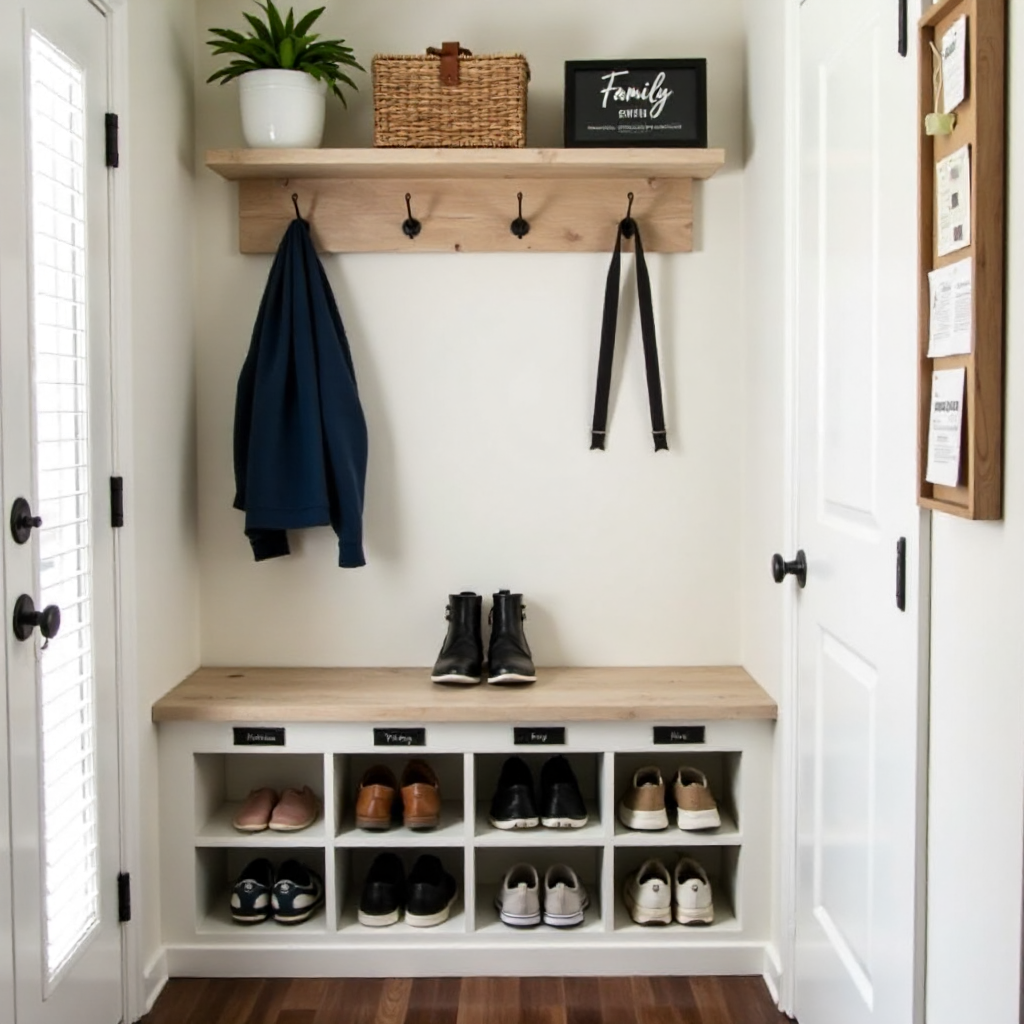
In shared living areas, an ottoman with storage does triple duty: seating, footrest, and toy or blanket container. A bench with cubbies at the entryway replaces a coat rack, a shoe rack, and a catch-all shelf in one piece. These aren't luxury upgrades — they're structural decisions that reduce clutter at the source.
Convertible pieces — fold-down desks, murphy beds, nesting tables — deserve mention here too, particularly for families using a single room as both a living space and a homework zone. The trade-off is that convertible furniture requires consistent habits to work; if the fold-down desk stays permanently open, it stops being functional. Build the habit alongside the furniture.
Taming Toy Chaos in a Tiny Home
Toy organization in a small home works best when you reduce volume first, then organize what remains. No bin system in the world can fix a toy collection that has outgrown the space.
The most effective approach most parents land on is a toy rotation system: keep one-third of toys accessible, store the rest in labeled bins out of sight, and rotate every few weeks. Kids engage more deeply with fewer toys, and the home stays manageable. It sounds counterintuitive until you try it once.
For the toys that are in active use, labeled bins and basket systems are the backbone of any sustainable setup. Labels with both words and pictures work well for pre-readers — they build independence and reduce the "where does this go?" question that derails tidying sessions. Assign one basket per category: blocks, cars, art supplies, stuffed animals.
Designated play zones matter too, even in tiny homes. You don't need a playroom — you need a corner, a shelf, or a low cabinet that signals "this is where toys live." When the zone is clearly defined, cleanup becomes a spatial task rather than a negotiation.
One common mistake: buying more storage containers before decluttering. More bins just means more organized clutter. Do a toy audit first — donate duplicates, broken pieces, and anything your kids have aged out of — then buy storage to fit what's left.
Shared Bedrooms and Kid Closets — Maximizing Every Inch
Shared kids' bedrooms are the norm in small-space family living, and they work well with the right setup. The key is giving each child a clearly defined personal zone within the shared space, even when the room is small.
Divided storage — separate shelves, cubbies, or drawers assigned to each child — prevents the "that's mine" friction that derails shared spaces. Color-coding bins or labels by child makes ownership clear without requiring a wall between them.
Closet organization in small bedrooms benefits enormously from a capsule wardrobe approach for kids. Rather than keeping every item of clothing a child owns accessible at once, maintain a curated rotation of what fits and what's seasonally appropriate. Store off-season clothing in labeled bins under the bed or on high shelves.
A seasonal clothing rotation also forces a natural decluttering rhythm. When you pull out next winter's bin, you assess what still fits before it goes back into circulation. Kids grow fast — staying ahead of the clothing accumulation is easier than dealing with an overstuffed closet twice a year in a panic.
Double-hang rods in kids' closets are a simple upgrade that immediately doubles hanging capacity. Children's clothing is short; a standard single rod wastes the bottom half of the closet entirely.
Entryways and Common Areas — Stopping Clutter Before It Spreads
The entryway is where clutter either gets intercepted or invades the rest of the home. A functional entryway station — hooks at multiple heights, a small bench or cubby, and a spot for bags and shoes — acts as a filter for everything that comes through the door.
Hooks are the unsung heroes of small-space family organization. Mount them at adult height for coats and bags, and add a lower row at kids' height for backpacks and jackets. When kids can hang their own things independently, the entryway actually stays clear.
A family command center — a wall-mounted board combining a calendar, mail sorter, and key hooks — keeps the kitchen counter and dining table from becoming paper graveyards. It doesn't need to be elaborate. A pegboard with a few hooks and a small corkboard does the job for most families.
In common areas like the living room, the goal is preventing flat surfaces from becoming default storage. Side tables with drawers, coffee tables with lift-top storage, and ottomans with interiors all give everyday items a home that isn't the sofa cushion or the floor.
Building Family Habits That Keep the System Running
Storage systems don't maintain themselves — habits do. The most beautifully organized small home will unravel within a week without consistent routines to support it.
The most sustainable approach for families is a daily reset: 10–15 minutes at the end of the day where everyone returns items to their designated places. This isn't a deep clean — it's a maintenance pass. When kids participate from a young age, it becomes unremarkable, just part of how the household works.
Age-appropriate tidying tasks matter here. A two-year-old can put stuffed animals in a bin. A five-year-old can sort laundry by color. A nine-year-old can manage their own closet rotation. Building these habits early, when the expectations are low and the tasks are simple, creates kids who are genuinely capable of contributing to a small-space household.
For family decluttering routines, a quarterly review tends to work better than annual purges. Every three months, walk through toys, clothing, and common areas with a simple question: does this still belong here? Donate, rotate, or discard. Keeping the volume of stuff in check is what allows any storage system to keep functioning.
The deeper truth about small-space family living is that the systems you build aren't just about tidiness — they're about reducing the low-grade friction that makes home life feel exhausting. When everything has a place and the family knows where that place is, the home becomes easier to live in. That's worth more than square footage.
Frequently Asked Questions
How do I store kids' art supplies in a small home without a dedicated craft room?
A rolling cart or a pegboard-mounted supply station works well in a corner of a bedroom or living area. Store supplies in labeled bins by type — markers, paper, glue — and keep only current favorites accessible. Rotate specialty supplies in and out of a higher cabinet to prevent overwhelm.
What's the best way to organize a shared kids' bedroom with limited closet space?
Add a double-hang rod to maximize vertical closet space, assign each child a clearly labeled section, and use a capsule approach — keep only what fits the current season accessible. Under-bed drawers handle overflow clothing and off-season items without requiring additional furniture.
How often should families in small homes declutter toys and clothing?
A quarterly review works better than annual purges for most families. Every three months is frequent enough to stay ahead of growth spurts and toy accumulation, but not so constant that it becomes a source of stress. Tie clothing reviews to seasonal transitions to make the habit easier to remember.
Can tiny home storage solutions work in a regular small apartment?
Absolutely. The principles are identical — vertical storage, multi-functional furniture, designated zones, and consistent habits apply regardless of whether you're in a 400-square-foot tiny home or a 900-square-foot apartment. The scale shifts, but the strategy doesn't. Many families in conventional small apartments find that reducing what they own has as much impact as any organizational system.
How do I get young children involved in keeping a small space tidy?
Make the system accessible to them — labels with pictures, bins at their height, and tasks scaled to their age. Toddlers can drop toys into bins; preschoolers can match shoes to a picture label. The goal isn't a perfect result; it's building the habit. Celebrate participation over perfection, and the routine becomes self-sustaining over time.